
Bankroll leverage spreadsheet: odds 1.30 and 1.50 tables (and the real risk)
Want to turn $100 into $1,000? Here's the step-by-step table for the bankroll challenge at odds of 1.30 and 1.50, plus the part almost every leverage spreadsheet hides: the real chance of making it to the end.
What bankroll leverage is
You bet your entire bankroll and, after every win, roll everything over (stake + profit) into the next bet until you hit your target. All it takes is one loss at any step for the attempt to go back to zero.
Bankroll leverage table at odds 1.30 (starting from $100)
| Step | Stake | Bankroll after the win | Chance of getting here |
|---|---|---|---|
| 1 | $100.00 | $130.00 | 73.3% |
| 2 | $130.00 | $169.00 | 53.7% |
| 3 | $169.00 | $219.70 | 39.3% |
| 4 | $219.70 | $285.61 | 28.8% |
| 5 | $285.61 | $371.29 | 21.1% |
| 6 | $371.29 | $482.68 | 15.5% |
| 7 | $482.68 | $627.49 | 11.3% |
| 8 | $627.49 | $815.73 | 8.3% |
| 9 | $815.73 | $1,060.45 | 6.1% |
| 10 | $1,060.45 | $1,378.58 | 4.5% |
Bankroll leverage table at odds 1.50 (starting from $100)
| Step | Stake | Bankroll after the win | Chance of getting here |
|---|---|---|---|
| 1 | $100.00 | $150.00 | 63.5% |
| 2 | $150.00 | $225.00 | 40.3% |
| 3 | $225.00 | $337.50 | 25.6% |
| 4 | $337.50 | $506.25 | 16.3% |
| 5 | $506.25 | $759.38 | 10.3% |
| 6 | $759.38 | $1,139.06 | 6.6% |
| 7 | $1,139.06 | $1,708.59 | 4.2% |
| 8 | $1,708.59 | $2,562.89 | 2.6% |
In the spreadsheet, the bankroll formula is simply =previous_bankroll*odds. The column that matters is the last one.
The math nobody shows you
The "chance of getting here" accounts for the typical bookmaker margin (~5%): at odds of 1.30, the real chance of a win is close to 73%; at odds of 1.50, close to 63%. To complete the challenge you have to hit every bet in a row, so the probabilities multiply.
Bottom line: from $100 to $1,000, the chance of completing it is around 6% to 7%. In more than 9 out of 10 attempts, the $100 is gone somewhere along the way. That holds at any odds if you don't have a real edge in the market.
That doesn't mean you'll never complete one. It means that, without knowing whether your bets have an edge, bankroll leverage is a lottery with extra steps.
If you're going to try it, do it this way
- Set the money aside: use only a small amount, outside your main bankroll, that you can afford to lose.
- Set the target up front: and what you'll do when you hit it (cash out part of it, for example). Without a target, the last step always becomes "just one more."
- Pick markets where you already win: the only way your real chance beats the table is to have an edge. And an edge only shows up in a logged history.
- Log every attempt: how many you completed, which step you usually bust at, how much you've put in overall. Plenty of people "win" two challenges and forget the ten they lost.
Log your bets in Sophos PRO (free)
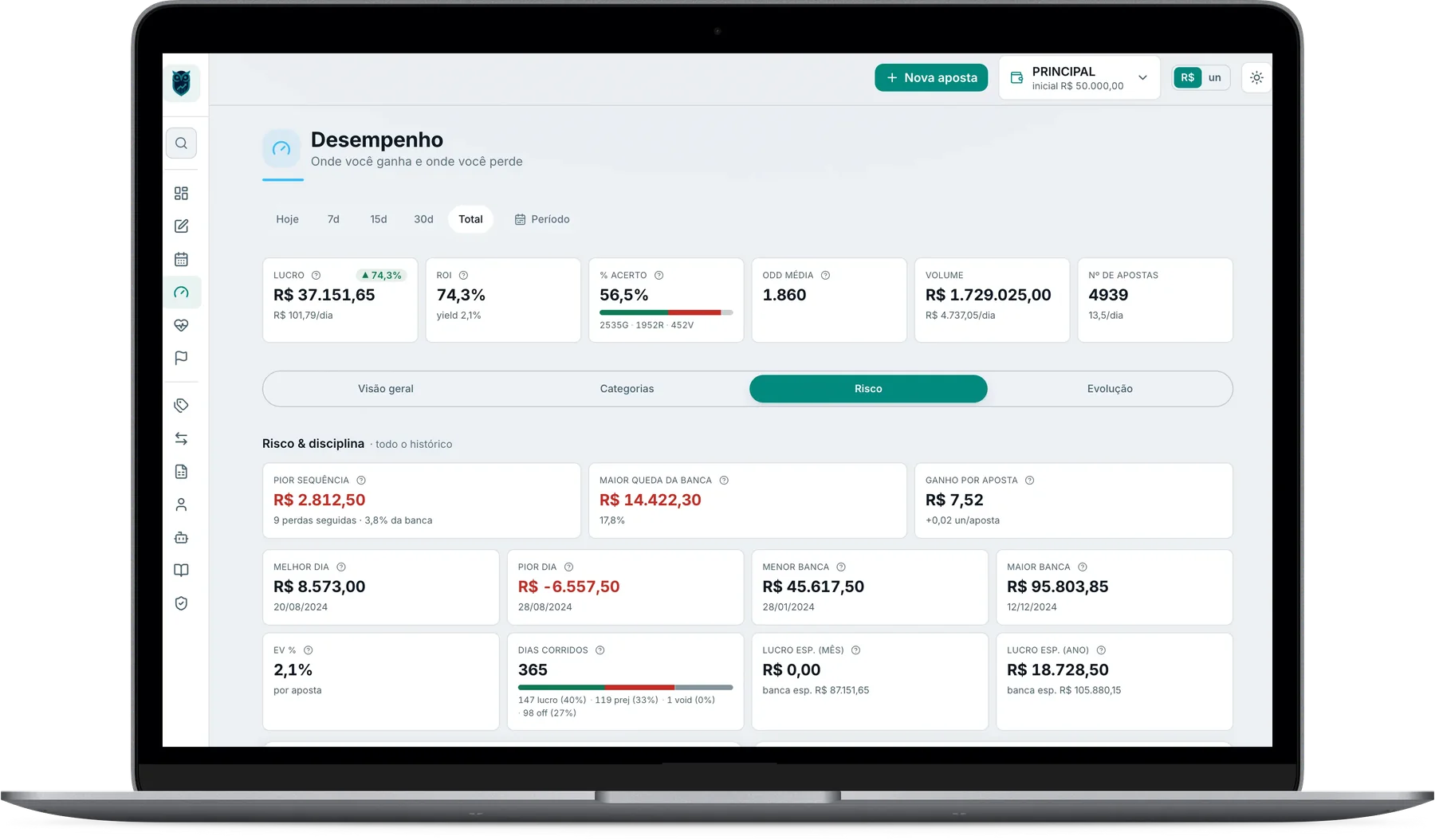
Sophos PRO is the bankroll spreadsheet that fills itself in: you log a bet in seconds (or snap a photo of your bet slip), and it shows your real profit, ROI, win rate and which markets and odds ranges give you an edge, which is exactly what decides whether a bankroll challenge stands a chance. It doesn't give picks and doesn't promise profit.
Frequently asked questions
What is bankroll leverage?
It means betting your entire bankroll and, after every win, rolling everything over (stake + profit) into the next bet until you hit a target. A single loss at any step wipes out the attempt.
How many steps does it take to turn $100 into $1,000?
At odds of 1.30 it takes 9 wins in a row ($1,060.45). At odds of 1.50 it takes 6 wins in a row ($1,139.06).
What are the chances of completing a $100 to $1,000 bankroll challenge?
Accounting for the typical bookmaker margin (around 5%), about 6% at odds of 1.30 (9 steps) and about 7% at odds of 1.50 (6 steps). In other words, in more than 9 out of 10 attempts the money put into the attempt is lost.
Odds 1.30 or 1.50: which is better for a bankroll challenge?
Mathematically it barely changes: lower odds need more steps, and higher odds have a lower chance per step. What decides it is having a real edge in the market you pick, and that only shows up when you log your history.
Does bankroll leverage replace bankroll management?
No. If you're going to try it, use only a small amount kept apart from your main bankroll (money you can afford to lose) and log every attempt so you know whether it's actually paying off.